
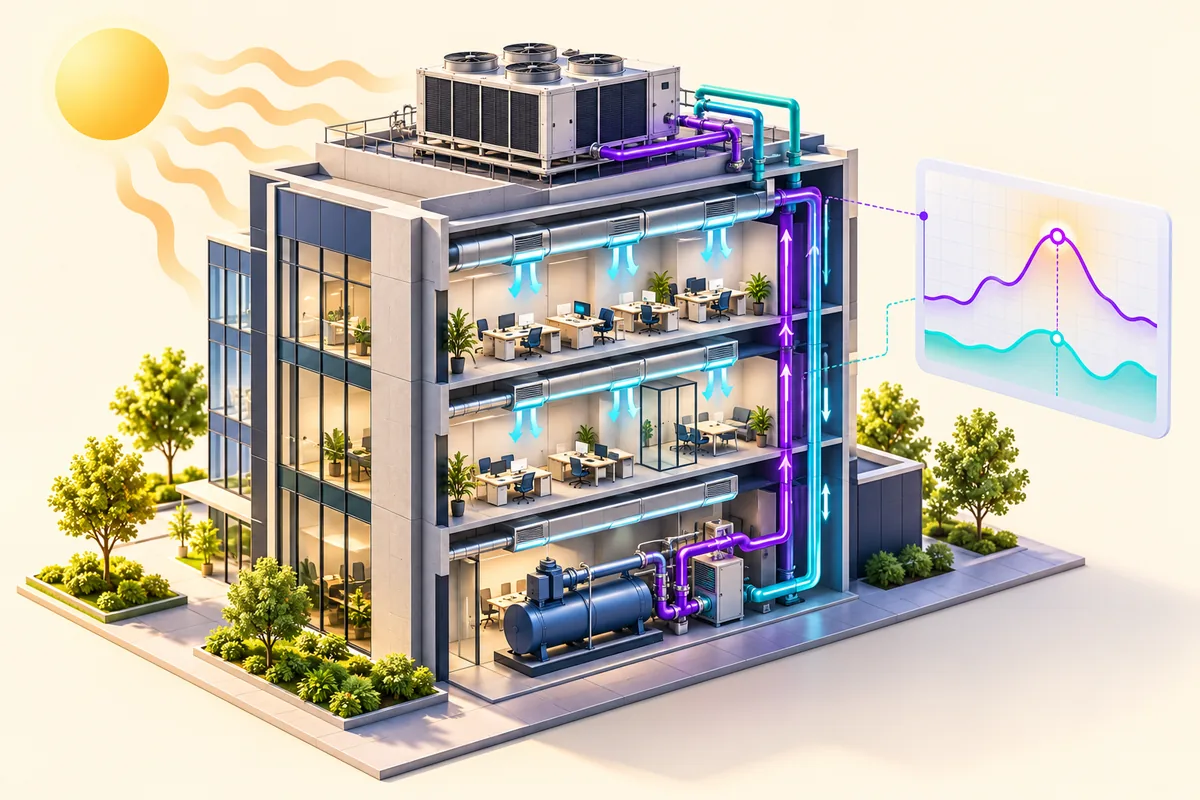
The building feels comfortable, the rooftop units are running, and nobody has reported a fault. Then the July electricity bill arrives. Consumption has climbed, and the explanation is simply that summer is expensive. That may be true, but it does not tell you whether the building is operating well.
A useful cooling review separates the load the weather creates from the load your operating choices create. Start with schedules and evidence, then move to equipment checks. This checklist helps facility teams investigate an expensive summer without turning comfort into a trial-and-error exercise.
In this guide
Start with a fair comparison
Compare equivalent periods before drawing conclusions. Record billing days, occupied hours, outdoor conditions, and any changes in tenant activity. A longer billing period can raise monthly kWh even when daily performance improves. A conference, extended retail hours, or newly occupied floor can also explain a legitimate increase.
Use kWh per day as a first check, then review weekday and weekend profiles if interval data is available. Keep electricity consumption separate from peak demand and total bill cost. Cooling can increase all three, but each needs its own explanation. A rate change is not an equipment fault.
Check the schedule before replacing equipment
Review actual start and stop times rather than the schedule someone remembers programming. Look for holiday exceptions, temporary overrides, and systems that start hours before anyone arrives. Check whether an early cleaning shift needs the entire building conditioned or only a small occupied area.
- Confirm operating hours with the person responsible for occupancy.
- Record current schedules before changing them.
- Identify spaces with independent comfort or process requirements.
- Change one schedule at a time and monitor the result.
Controls should match the building's needs, including humidity, ventilation, and critical equipment requirements. Do not assume an empty office means every system can be switched off.
Inspect the equipment that creates the load
Ask a qualified technician to check filters, coils, sensors, airflow, and control sequences. A dashboard can identify a pattern; it cannot establish that a refrigerant charge is correct or that a damper is physically moving. Compare commanded operation with what the equipment is doing.
Check exposed sensors and zones that frequently call for extra cooling. A sensor in direct sun, a blocked return path, or a local heat source can distort the signal controlling a much larger area. Record the finding and the repair rather than merely resetting the alarm.
Watch for a new demand peak
A building can use less energy overall and still set a higher billable peak. Review the intervals around morning startup, especially when cooling, kitchen equipment, charging, and other large loads begin together. Whether that peak changes the bill depends on the account's tariff and billing rules.
Where equipment and operating requirements allow it, assess staggered startup with your controls contractor. Verify that the revised sequence reaches comfort on time. A delay that creates complaints will eventually be overridden, taking the savings with it.
Work through the scheduling math
Consider an illustrative office where measurement indicates 18 kW of avoidable average load during two unnecessary operating hours each weekday. Across 22 weekdays, the estimated reduction is 18 × 2 × 22 = 792 kWh. At an assumed marginal energy price of $0.15/kWh, the energy component is about $118.80.
This is an estimate, not a promised result. The 18 kW must represent avoidable measured load, not the equipment nameplate. Fixed charges remain. Demand savings require a separate calculation, and warm-up or recovery energy can reduce the net benefit. Check the changed profile after implementation.
Make comfort part of the verification
Compare occupied temperatures, humidity where relevant, and complaint records before and after the change. Use several comparable days rather than one cool afternoon. If outside conditions differ substantially, flag that limitation before claiming savings.
The Department of Energy's overview of building controls explains the role of controls in building performance. For your site, the practical question is whether each control action produces the intended physical result.
Your next seven days
Choose one air-handling or rooftop system. Gather its schedule, a week of consumption data if available, and the associated comfort observations. Assign an owner to check overrides and a technician to investigate physical faults. Approve one reversible change, record it, and compare the next operating week.
A successful summer review produces a short list of verified fixes. Keep that list with the building's operating record so the same override does not become next July's mystery.
Turn your next energy review into action
Bring your utility records, operating observations, and improvement priorities together with Energy Wiz.
Get started